The kettle tells you before anything else does
Boil a kettle for a month in Sitio de Calahonda and look inside it. There will be a pale crust on the element, and by the end of a year it will be thick enough to flake. That crust is calcium carbonate, and it is what the water leaves behind when it is heated.
Nobody in the north of England sees that in a kettle. It is the clearest evidence you will get that the water arriving at your kitchen tap is carrying a lot of dissolved mineral, and once you know it, everything that happens in the bathroom stops looking like bad luck.
What the crust does to a shower
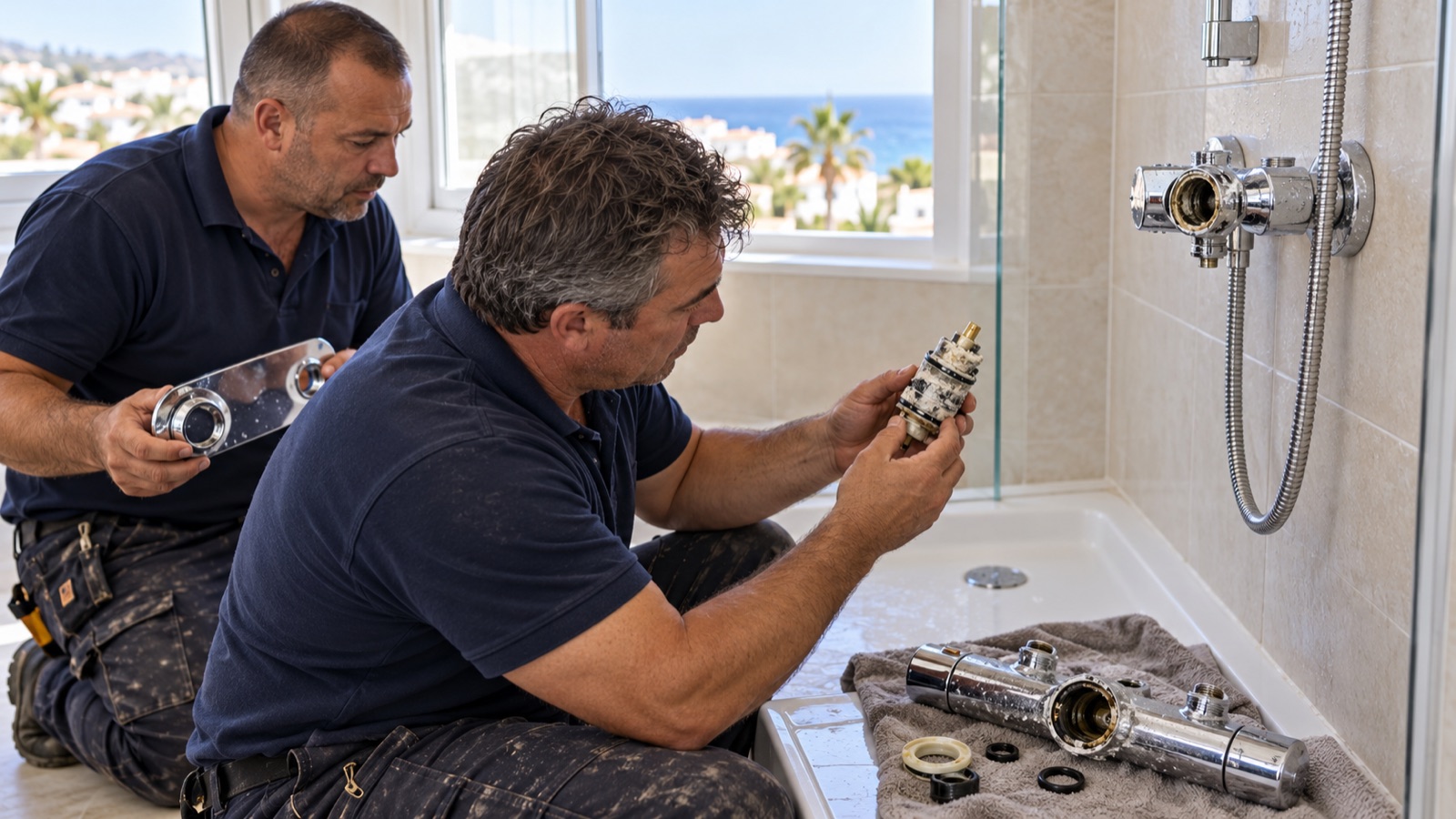
Inside a thermostatic shower mixer there is a cartridge, and inside that cartridge is a small element that moves to balance hot and cold. It has a narrow travel. Scale builds on the surfaces it moves against and the travel shrinks.
At first nothing happens. Then the temperature starts to drift, hot then cool then hot, and eventually the cartridge sticks. Guests and owners describe it as the shower being broken. The valve is fine. The cartridge is a part, and it is the part that fails on this coast far more often than anything else in the bathroom.
The same process closes up the spray holes in the head, which is why a shower that has been fine for two years suddenly feels weak. That one is a ten minute job with a pin.
Where it causes real damage, and where it only annoys you
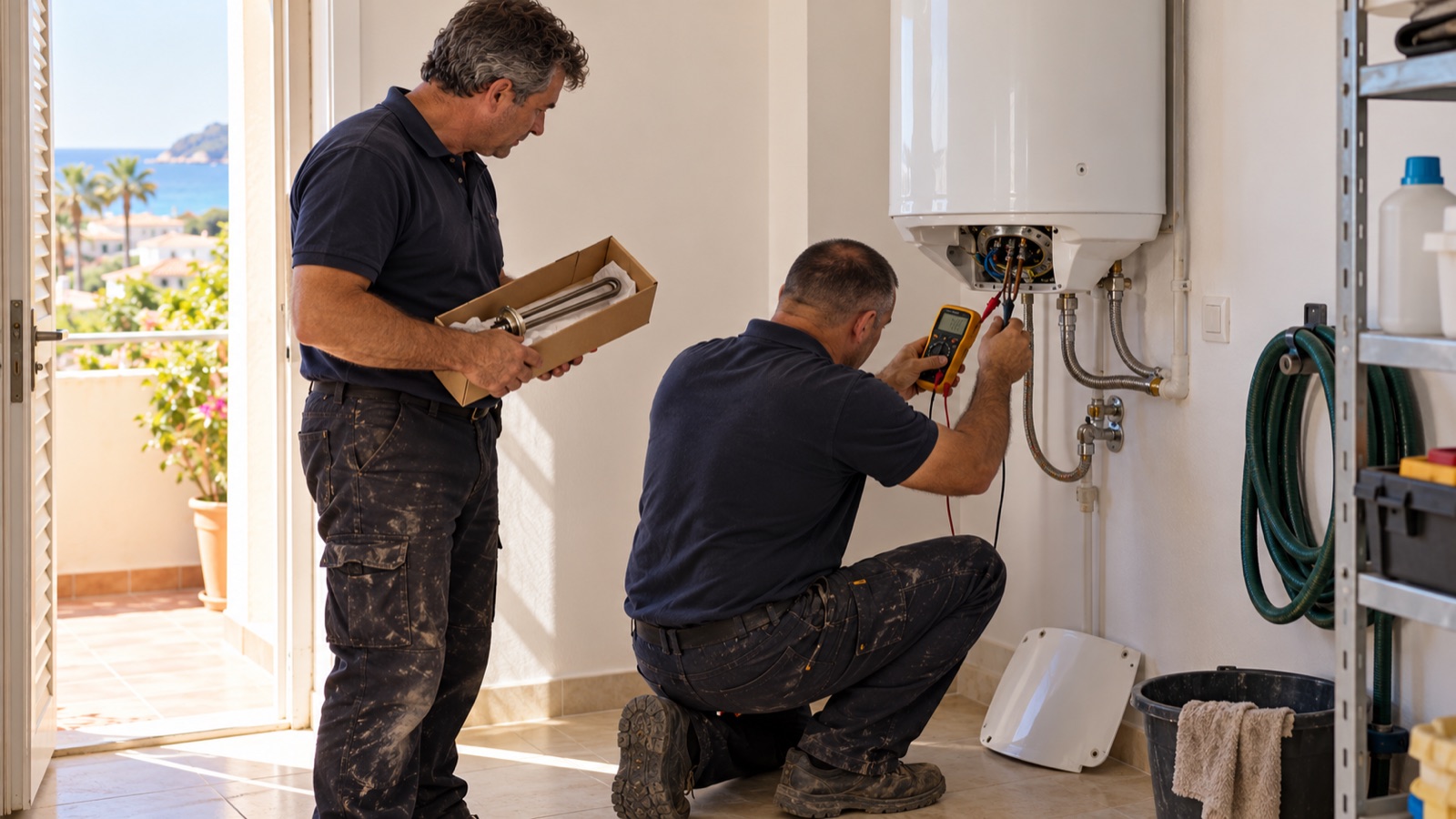
A kettle and a shower head are inconvenience. The water heater is the expensive one. An element sitting in hard water collects the same crust, and because the crust insulates it, the element has to stay on longer and run hotter to heat the tank to the same temperature.
Two things follow. The element fails years before it should, and the heat it is putting out to overcome that crust has to go somewhere, which is how a cylinder ends up corroding from the inside. A unit that would give fifteen years or more inland gives five to eight here, and the ones in the oldest blocks give less.
Washing machines, dishwashers and coffee machines all collect the same deposit. They are not our trade, but the cause is identical and worth knowing.
Why the older urbanisations suffer more
Age is most of the answer. A block in Calypso or Jardines de Calahonda that was plumbed in the years after the community was first laid out has been passing the same hard water through the same narrow bore for decades. The scale is not on the surface. It is a lining.
Calahonda makes this worse in a specific way. The whole area is apartment-led, spread over well over a hundred separate sub-communities, and much of that stock is older than the people fixing it. Narrow waste runs and small-bore supply pipework leave less margin than the larger plots up the hill in Elviria, where a run has more room before scale starts to matter.
The newer buildings around El Campanario and the upper parts of Sitio de Calahonda are not immune, they are simply younger. They will arrive at the same place.
What actually slows it down, and what does not
Scale that has already formed is not coming off with a bottle of anything. Descalers sold for kettles work on the loose deposit and do nothing for a cartridge or an element. What helps is reducing the rate at which it forms and catching the parts early.
Turn the cylinder down. Scale forms faster at higher temperatures, so a unit set to maximum is scaling its own element faster than it needs to. If nobody has touched that dial since the last owner, it is probably sitting at the top.
Replace a shower cartridge when it starts to feel stiff rather than when it seizes. The part is cheap and the valve is not, and stiff is the warning you get.
Empty the kettle and dry it rather than leaving water standing in it. It will not stop the crust, but it slows the flaking.
A water softener is the only thing that changes the water rather than living with it. That is a larger decision, and it belongs in a house you own rather than in a rented flat where the supply is shared.
When it has gone too far
If the tank now needs appreciably longer to recover after anyone showers than it did eighteen months ago, the element is heating through mineral rather than water. That is still the cheap end of the problem, and it stops being cheap once there is no hot water at all.
Rust-coloured water from the hot tap, or a stain spreading under the cylinder, is a different message: the tank is going, and no amount of descaling will bring it back.
We work in these buildings constantly, so we know which ones are running original pipework and which have been re-plumbed. If you are in Calahonda and want an honest view on whether your water heater is worth keeping, send us a photo of the rating plate rather than a description. The make and model decides most of the answer before anyone gets in the van.